Wednesday, April 10, 2013

Hope and industry: An evening in Dadar...


The young well-built lad swung his bat ferociously making an unmistakable connect with the swinging white ball, which traveled up in the air some 15 meters and crashed into a window pane of a third floor apartment. Miraculously, the glass did not shatter. Instead, the ball bounced off the window pane and floated down to the ground sluggishly where 3 able bodied fielders vied with each other to catch it. They laughed and screamed, jostled and pushed each other for a vantage position. It was as though they were making space for themselves in a crowded Mumbai local train by digging into the ribs of the person next to them. All of them had their hands cupped to receive the ball, as though they were about to receive offerings at a temple. All of them wanted to be the catcher that had dismissed the burly batsman. The ball, though, had other ideas. It popped out of their collective hands and landed on the ground making a tinnish sound; the sound a table tennis ball would make. 

The batsman received a reprieve.
 
This was a match that took place under lights on Tulsi Pipe Road in Dadar, Mumbai in a paved courtyard, about 15m wide and 30m in length. This floodlit cricket ‘ground’ was enclosed on one side by a tin industrial shed and on two sides by tall apartment blocks. The cricketers played with a special, light ball which ensured that windows would not get broken. The lighter ball swung much more than a normal cricket ball would. 

The batsmen played with immense skill and strength and thrilled the large, wild audience that watched and cheered as they played. The boys, all from nearby dwellings, cried, shouted, laughed and thumped each other on their backs as they sweated their way through this sticky Sunday evening. We stood there for a while, appreciated and applauded the fun as well as the skill that was on display.

To me, this was the Mumbai I had known and loved as a young boy who had spent many of his summer holidays here. A Mumbai of people from Dadar, Byculla and Matunga, the Mumbaikars who make the place what it is; the sort of people that do not venture much into the Bandra and Worli sea-face locations of Bombay that is inhabited by Bombayites. The Mumbai I knew and liked contains stories from Byculla, Matunga and Dadar and does not include fancy lights, nightclubs, fashion shows, bling and Bollywood. The Mumbai I feel, smell and appreciate is a hub of dizzy activity where people get by, survive and maybe – just maybe – get ahead.

It is this Mumbai that I wanted to feel and experience when I went to Dadar a few weeks ago with my wife and a few friends. We had no particular objective or destination in mind. We just wanted to walk, smell and feel the Mumbai we all loved. We started our exploration at 6pm on a Sunday afternoon from Tulsi Pipe Road at the cricket ‘ground’, walked up to Shivaji Park and back.

We crossed a permanent makeshift – yes take that paradox and cope with it as I do, everyday – market under a flyover on Tulsi Pipe Road. A police van stood by the side of this dimly lit market to ensure that the improvised temporary stalls were appropriately lasting. There was a surreal sense to the irony and I could only smile as I walked through this under-the-flyover market. Smile I did until something harshly corrosive in the air made me simultaneously rub my eyes and clutch my throat. The acid in the air may have been released by the constant trampling of vegetable leaves (probably radish), marigold stems and green chilies. The air was pungent, yet the vendors shouted out loudly, announced their wares and advertised their prices. The pungent air did not trouble them at all. Each hawker sold the freshest produce at least price. Around them, people walked busily and briskly towards an unknown destination.

There, an old man slept peacefully in a bed made up of two slabs of stone, his head rested on one stone and his feet on the other; his torso, suspended in between. He slept, completely oblivious to the strong, sharp air and the frenzied chaos around him. He didn’t even move as a motor bike honked its way through this crowded market, missing him by just a few feet. ‘How did this bike even get there, leave alone maneuver through it,’ I thought.

We exited from this hyperactive and busy market and spilled into the main Dadar market to see a sea of humanity in front of us. From where I stood – a slightly elevated part of the road – all I could see was a sea of heads. 'Surely the people were stationary while the ground moved underneath them,' I thought. How else could we get through this human mass? We did, occasionally receiving a nudge in the ribs. Mumbaikars are adept at moving in small spaces; they dodge and weave lithely through even the tiniest of gaps. 

Sometimes I would exchange a glance and a nod with other people, but mostly everyone was focused on their individual destinations. I could not ascertain if people were happy, content, sad, tired, busy or dejected. It appeared as though all of them had a job that had to be accomplished and what I felt was intense industry in whatever people were doing.

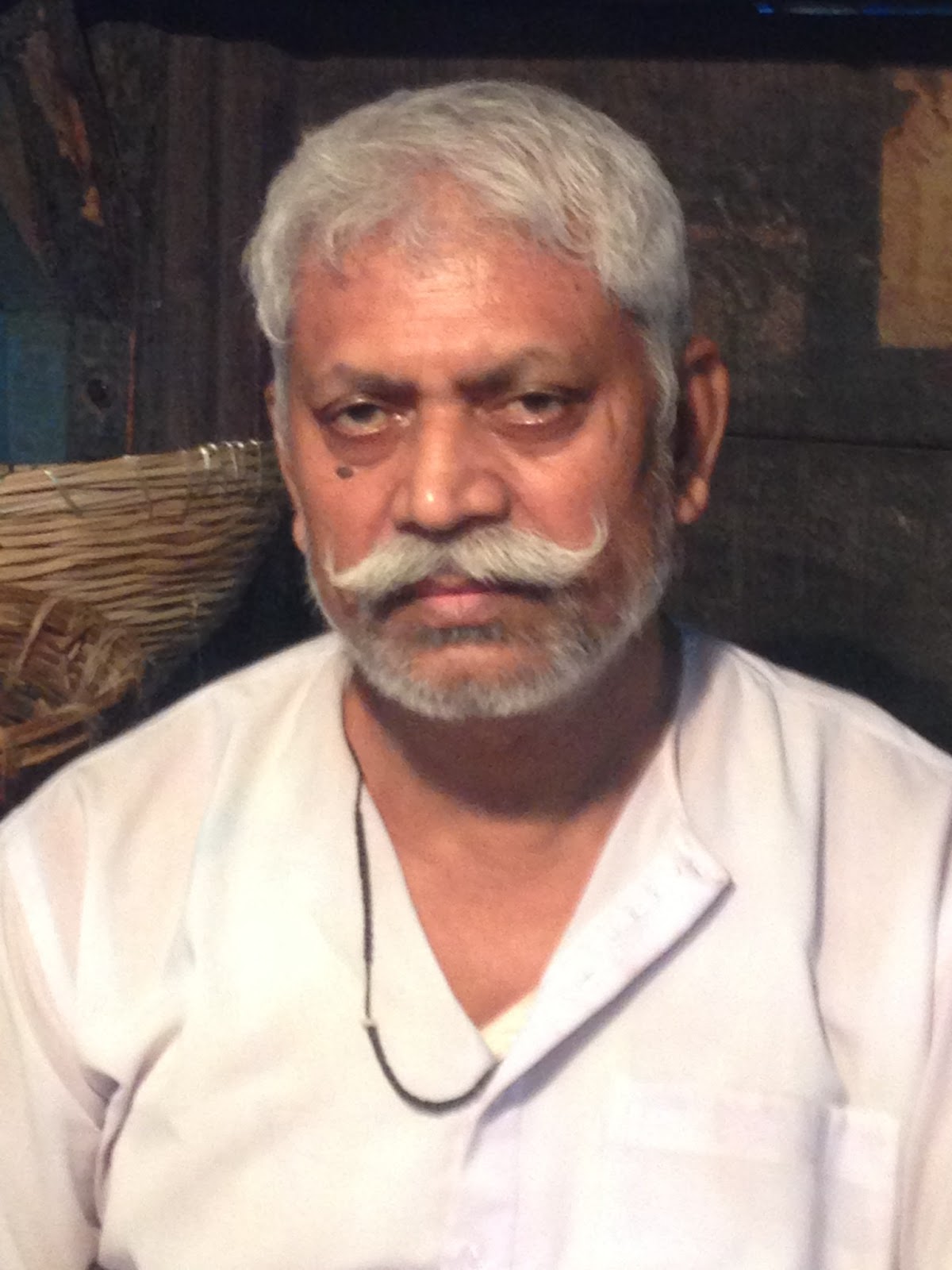
This sense of industriousness included Ram Chand, a vegetable vendor, who smoothened his mustache proudly as he announced his produce and shouted out the price of his merchandise. He said to one of his prospective buyers that he would not entertain any bargaining and twirled his mustache flamboyantly as he said so.

We walked up through the markets and walked around Shivaji Park and saw people – many people – walking, laughing, talking and relaxing. 

Out in the maidan itself, we saw kids play cricket and soccer in fading light. All these kids had proper cricket kits and played with cricket balls that thudded against well oiled bats. A few of the netted cricket pitches were floodlit as young bowlers charged in – in whites – to bowl to well-protected young batsmen. “Get behind the ball. It is all about technique,” a coach shouted in Hindi at the recognized nursery of Mumbai’s cricket. That was exactly what the lads were already doing at the Tulsi Pipe Road ground against a lighter ball that swung maniacally and unpredictably in the air.

It was close to 10pm when we returned to where we had parked our car after dinner at Prakash Hotel. The market was still a hive of activity. The police van still stood there. The men inside it cast a protective eye on all the temporary stalls. The acid hung around in the still air; it would perhaps stay in the air until the trampled and crushed leaves could be gathered and taken away. Vendors still shouted their prices. Ram Chand continued to twirl his ostentatious mustache  The cricket match continued in the paved courtyard on Tulsi Pipe Road.

The sleeping old man was gone though. In his place were two young girls, one each on the two stones that had propped up the old man. They were probably ten years old. In poor dim light, as their parents sold vegetables or food nearby, they read from an English text book. Their heads bobbed up and down as they tried to learn their lessons, probably for their school exams the following day. I stood there, mesmerized, as they recited their lesson. I could not make out what it was they were memorizing. Perhaps it was a poem. Perhaps it was a story, an essay. I did not want to pry, so my friends and I smiled in appreciation and turned away slowly. I do not know why, but I was filled with hope...

The cricket players on Tulsi Pipe Road shouted one last time. It wasn’t clear who won. But everyone was happy and amidst much back slapping and mirth, the flood lights were turned off. Elsewhere, in an apartment, another light came on in this city of industry: home to several million hopes.

--Mohan (@mohank)

Saturday, April 06, 2013

If only we cared...


I stood unsteady on the balcony of our 18th floor apartment and held the rails tight because of the mild vertigo I suffer from. My wife was baking an inventive dessert our guests that evening wouldn’t be able to pronounce. Having given up desserts just over four weeks ago, the thought of a violent clash of the cherries, chocolate and coffee was enough to drive me into paroxysms of desire. I desperately needed something between me and this dessert preparation.

The balcony looks out west into a vast green expanse – somewhat of a luxury in Mumbai – and down onto a man made lake created when developers emptied a quarry that existed there. All around me, I could see a glimpse of life in the other apartments. The foul, pungent stench of stagnant water, heat, acrid dust, open drains, sweat and shit -- human and animal -- was strong enough to overpower any smell, including the beautifully mutinous fragrance coming from within the house. The outside smells formed a perfect antidote to my craving, and was a ready example of the paradox that life in Mumbai represents.

Like the dust and smoke, there was nowhere for the smells to go. They hung around uninvited, creating a haze: a confused cohort awaiting instructions from an unknown someone. In less than two minutes, I was also sweating profusely and my t-shirt clung to me. The haze reminded me of the pub I used to frequent in South Kensington in London in the days when customers could still smoke in pubs; and it seemed everyone smoked. The dense pall would represent a smoke-mixture: from the open fireplace, cigarettes, cigars and pipes. It would lift to eye level, hang around my face and sting it repeatedly.

If I looked around, all the balconies like mine offered to me the stories they contained, encouraging the casual voyeur in me, fueling my understanding of life and people around me.

The smell of cigarette smoke made me turn in the direction it wafted from. I looked to see a young couple smoking on their balcony. The young man wore dark-rimmed, thick glasses that rested uncomfortably on a very large, bulbous nose. The woman puffed on her cigarette lazily and appeared to relish her experience while the man appeared to be hurried. Soon the reason became obvious as the man lit another cigarette even though the present one was still only two-thirds complete. 'Isn't there enough in the air we breathe to additionally introduce tar into our lungs especially on a sweltering day like today,' I thought. I would have asked the same question of myself if I had been the one smoking. And when the couple were done, they turned inwards and without even looking back, casually flicked the stubs outward; the cigarette ends spiraled pitifully to the road below.

Elsewhere, a woman watered plants. Pointlessly. Wastefully. She must have just had a shower, for a thin towel covered her hair. Did she have curly hair? Straight? I did not know and the towel wouldn't let me in on those secrets. ‘Did she know the plants would retain as much water as a sieve in this afternoon heat?’ I wanted to ask.

There I could see a pot-bellied man in his vest. He stretched lazily. Perhaps he had just had his lunch. He had in his hands a small packet. His gold ring glimmered as the sun’s rays bounced off it. He tore open the packet and emptied its contents into his palm, briskly slapped his palms to his face and hurled its contents into his mouth. He then flung the empty packet out his balcony and rubbed his palms, satiated. The piece of plastic sailed lifelessly and rested on the pavement below. The man returned to the comfort of his air-conditioned living room, perhaps happy that it was still neat, well-accessorized and completely devoid of plastic wrappers.

Somewhere else, a maid hung out the washing with quiet care, picking up a piece of clothing from a clothes basket, untangling it, shaking it vigorously to straighten it, and finally straining to reach the clothes line. Sweat poured from her face.  Occasionally, she would catch her back as she strained it. It was clear she had a sore back. Just as clear as the fact that these clothes were hung on a balcony that faced the road, for the world see. Yellowed, crinkled, sometimes bright white fabric stories forced into the vision of those who happened to look up. I was sure they had another option to this balcony and wondered why they didn't use it. This relentless sun would surely reach an inward-facing balcony too? The maid, though, was too focused on her immediate task to worry about and look at anything else other than the clothes basket below and the clothes line above.

As my arms got wetter with my sweat, I watch everyone disappear indoors, gradually. The heat my body gave out must have smelt of blood because a mosquito landed on my arm and I idly wonder how it got to the 18th floor. I admire its resilience and strength; instead of swatting it, as a reward, I offer the mosquito use of my hand for a full minute before blowing its drunken, swollen body away. The lack of wind may have helped its flight up 18 floors. Or perhaps the mosquito had arrived in one of the three lifts in our building, two of which may not be used by "workers and maids."

By now, I find myself begging for some air to cool the sweat off. One part of me is also playing a game, to see how long I can hold out in this quiet heat that is made oppressive with so many stories. Ahead, I see the green of the lake and think it would be lovely if it had a fountain in the middle; a fountain to circulate the water so it didn't stagnate. What I see, though, is still water that could be beautiful if only someone cared: If the maid that hung the clothes despite a sprain in her back stopped to stare. If the person who flicked that cigarette butts cared. If the person that watered plants on a hot day cared.  If the man who flung the plastic wrapper onto the road cared.


And if I cared...

-- Mohan (@mohank)

Monday, March 25, 2013

Conquering Heart Break Hill


Running hills is a necessary part of endurance training. You just have to run hills if you want to run long distances. And like a lot of things in the activity itself, running hills is much more of a mental exercise. A runner has to instruct their body to propel themselves up a hill. I had read all the material on ‘attacking hills’. There is enough literature to suggest that a hill runner must look ahead 50 metres at least, that they must try and shorten their stride, manage their centre of gravity, activate their core muscles and lean into the hill. A friend of mine who loves running hills told me to continuously say to myself ‘I love you hill’ rather than moaning or saying ‘Damn you hill, this is hard work’ as I ran. I knew the theory, but failed in putting all of this into practice. As with most of my running itself, I learned this lesson the hard way on Heart Break Hill.

Running has been my religion for a long time, and nothing could stop me from engaging in it every day. Not the heat, dust, stench, the pain or my own inabilities; I just have to run. Every morning.

I am normally up every day at 4.45am – even on Sundays – and am out pounding the pavements soon after. I hate treadmills these days. I used to run on them almost always when I lived overseas, where I began my love affair with running. Not anymore, since my move to Mumbai. Counter intuitive, if you actually thought about it. First, the air quality is significantly worse in Mumbai than almost any other city in the world I have run in. Moreover, there are few pavements in Mumbai to run on; pavements are to runners what water is to swimmers. Most Mumbai roads come with potholes and debris, which is not at all good for runners. And if all of this wasn’t enough to make life hell for a runner, there are the smoke-billowing vehicles that vie with the other two hazards on Mumbai roads. Yet, I love running the roads of Mumbai. 

After my move to Mumbai, I identified and carefully mapped out several tracks around my home. I can be quite boringly meticulous. ‘You are definitely a four-letter word contained in analytical,’ my friends often tease me. I mapped out a three-km route, a five-km route, a six-km route, a seven-km route and a 10km route. Sometimes, especially on a Sunday, I would run the same route twice or add a few of the routes together to make up a longer run. Many of these routes would take in the smoke, the dust, the stench and the exciting life of Mumbai, a city that is interesting even at 5am. Occasionally, I would run past a park with the fresh morning wind blowing in my face. And sometimes I would run past pavement dwellers too. Many of them would be fitfully asleep, completely oblivious to the sound of traffic around them. Most had a simple, thin cloth protecting them from the dust, cold, rain and vehicle smoke. Some of them would be stirring and a few would just look and smile at the walkers and joggers who walked or ran past. Those who were up would often be laughing and joking amongst themselves as they ushered in a new day. 

I often ran with either Neha or Kapil, sometimes both of them. We are a good running group. I have always believed in running at a talking pace; not that the three of us talked a lot. For us, running was a time for either introspection or meditation, for focusing on the self, and for reflection.

As I ran, I would often reflect on the unresolved arguments I had left behind me (or run away from) or the challenges ahead of me. I would often ask myself difficult questions about my behaviours and responses. Was it right to be that intense? Should I have let go? Should I have argued as passionately as I did? Was I being too selfish? Did I understand fully at all? Did I understand enough? Should I be more accepting of people? Should I be less judgemental ? The questions swirled around. I did not have an agenda or a list of questions; they just arrived in my head as I ran and I confronted them without fear and mostly, with honesty. Or so, I thought. And although I ran with Neha and Kapil, this was exclusively my time.

Each of us would have only one ear plugged for music. The other ear was open to the occasional question or comment from the other two. Every now and then, one of us would say something and the others would contribute to a quick conversation. But mostly, we focused, introspected, listened to each other’s breathing and ran in silence.

Most of our conversations, when we did talk, revolved around pain. I had accepted pain as a way of life and loved the challenge of overcoming this pain. To my fellow running mates, I understand pain. Running has taught me that. Ten years ago, I would barely run 100 metres before collapsing in a heap from pain in my shins, or my calf muscles or in my lower back; sometimes, all three. On those days, I thought I would never be able to run again. I always wanted to. Badly.

I have gazed at runners with a mix of awe and respect. I loved and simultaneously envied the way runners could effortlessly glide across running tracks and cut through hard pavements. I loved to hear the sound of running shoe scratching bitumen. I loved the grace and the gait of a runner. But mostly, I enjoyed seeing runners tell the story of their running through their repeated and, perhaps, monotonous motion. Back in the day, when I could not run, I looked for that story in every runner. The story of the runner coping with their fatigue, or pain; of focusing on the process and not the destination; of the runner spraying water all over themselves to cope with heat; of the runner plugging away despite the exhaustion, or simply enjoying their run. I wanted to embrace the trail. To me, this was an unrealized dream. So I taught myself to accept and, slowly, overcome the pain of running. And slowly, I taught myself to run. Small distances at first, and then the longer distances invited me. Even today, I am not free from pain. My pain would always start in my shins in the first kilometre of my daily run and this pain would soon travel up to my glutes by the time I had clocked three kilometres. And that pain would often remain with me right through my run. I would merely block it.

Paddy, a running mentor of mine had once told me about the mind-body-intellect framework and I used that framework to overcome and block out my everyday pain. The physical pain is transmitted by the body, the vehicle. The mind would feel the pain immediately. But I had been taught to work on my rational intellect – in this mind-body-intellect nexus – and had taught it to be independent of the mind. I had conditioned the intellect to quietly observe, moderate, regulate and counsel the mind. The intellect won... mostly.

I woke up that particular morning; getting up was always the tough part. That day, it was made tougher because the previous day was a bad one for me. I had had a few unpleasant, hurtful, testy and unhelpfully fractious arguments. I felt the need to introspect deeply. I had to learn more about myself, my reactions, insecurities, discomfort, judgemental behaviours and my own needs. I was in a dark and somewhat uncomfortably unfamiliar space. And as I stretched in preparation for the run, I knew I had to run hard that morning. I knew that this would not be like any of my other runs.

I secretly hoped that Neha and Kapil would not run that day. Although they ran ‘alone’ even when we ran together, I wanted to be totally on my own that day. As if by magic, Neha and Kapil had both informed the watchman that they would not be running; one had a dodgy knee and the other had a cold. ‘This is perfect,’ I thought to myself as I stepped out into the cool morning.

I decided I would run 10 kilometres that morning and would also set off at a faster pace. I discarded all my carefully mapped out routes and, instead, ran towards the hill. The hill formed a picturesque backdrop to our apartment complex, dwarfing the tall, majestic buildings, giving them a sense of their own fragility. A few months earlier, I had driven towards the hill and mapped out a course on this reconnaissance drive. I wanted to accept the challenges the hill posed. But the path that I mapped out during my earlier reconnaissance was discarded by my running group. But things were different this particular morning. I was on my own.

So, this particular morning, I ran towards the hill at pace. I did not know what it was called. So, I named it Heart Break Hill. The Boston Marathon has a Heart Break Hill, a rise of approximately 30 metres over a 600 metre stretch; a gradient of about 5%. I had run ‘The Tan’ (short for Botanical Gardens) in Melbourne regularly. This track includes a killer stretch along Anderson Street; an incline of 27 metres over a 75 metre stretch. My own Heart Break Hill was an incline of 120m over a one and a half kilometre stretch; a gradient of about 8%. It was reasonably hard and I hadn’t run that hill before. That day, I was presented with the perfect opportunity.

As I had different playlists for different days and different moods, I selected a playlist that included Springsteen, Sting, Pink Floyd, Tom Petty, Peter Gabriel, Talking Heads and U2. The lyrics did not matter. The rhythm did; all of the songs had to be at 80-85 beats per minute. I strapped on my heart rate monitor, pressed the start button on my Garmin and set off purposefully. I had to conquer that hill this morning.

It was three kilometres by the time I reached the bottom of Heart Break Hill. By then, my shin pain had already set in; it struck me a bit earlier on in the run that morning. I tried to block it out, but it was hard. My mind wasn’t entirely under my control that day. I reflected and tortured myself as I ran. I thought of my BMI guru: ‘the intellect always has to be independent’ was the voice that kept ringing in my ears. But the intellect was a slave to the mind that day; a mind that was focused totally on deep introspection in a dark and unfamiliar space. The intellect was no longer independent; it was hardly even present. The mind had taken over, felt the pain and the course and all of this coalesced with the confusions that emanated from an unfamiliar space. To make matters worse, just as I reached the bottom of the hill, my breathing shortened – an indication that my asthma was kicking in. Asthma is something I have been dealing with since I was five years old. I was so terribly unfocussed that morning that I had forgotten to puff on my Ventolin inhaler prior to my run. But I could not throw my hands up in the air and head back home. I focused immediately on regulating my breathing; three short exhalations and one long inhale. This was already tough work, even before I reached the hill that I was determined to conquer.

My breathing was short and raspy. My pain had intensified. Freddie Mercury sang ‘I want to break free’. Ironic. ‘Break free from what,’ I thought to myself. I continued to attack the hill mercilessly. One step at a time; one breath at a time. The stride shortened as did my breathing and I slowed down to a painful seven kmph. Half way up the hill I did encourage thoughts of giving up, although giving up was not why I ran. I did not know how to give up. I could not handle failures or disappointments through lack of trying and I had never run away from a battle. I had to know that I gave it my all; that I had tried my hardest to conquer, to understand, to comprehend. It mattered to me that I fought myself and warded off my own demons and limitations in a bid to understand myself better. The hill had to be defeated; it had to be conquered this morning.

The phrase ‘conquer’ rang in my mind constantly as I ran. I was three quarters of the way up the hill when cramps set in – in my calf-muscle. I had slowed down to 6.5 kmph and my heart rate monitor beeped alarmingly. My heart was going at a crazy 182 beats per minute, a good seven points above my suggested/theoretical max heart rate. I had never seen the dial reach 182 beats per min in all my years of running. I considered stopping and walking up the rest of the hill to the peak. But then I wasn’t about to give up. The hill just had to be conquered that morning.

Then, with 250m to go to the peak of that hill I suddenly remembered what Raju Martolia had said. Raju is this incredibly calm, very collected, supremely able and wonderfully fit Garhwali guide who had accompanied us on all of our Himalayan treks and climbing expeditions. Every day, after our trek had concluded, our trekking group would talk, mostly about other trekking and climbing experiences. One day after our day’s trek, as we relaxed around a camp fire, I asked Raju to tell us about the toughest mountain he had ever conquered. Raju’s face immediately registered a mix of shock and hurt. He was taken aback and said, “Sir, we Garhwali people do not conquer mountains. The mountain is a goddess for us. We take her permission to use her for our own benefit. I have never ever conquered any mountain.” He went on to explain this was why Garhwali guides would never place a flag at the very peak. A flag at the peak would suggest that the expedition had ‘conquered’ the mountain. “We always place the flag a few metres short of the peak. If we think we have conquered the mountain, our goddess has a way of teaching us unpleasant lessons on the way back,” he said.

I remembered those very words as I tried my own very unsuccessful hill conquer expedition.

As soon as I recollected Raju’s words, I realized I was doing it all wrong. I slowed down and sought permission from Heart Break Hill instead. I wasn’t angry anymore. I wasn’t confused anymore. My rational intellect was suddenly freed. I had nothing to prove. I wasn’t fighting myself anymore. I could give up if I wanted to. I could let go. This wasn’t a fight to a facile victory. This was me trying to understand myself more, be accepting of my own limitations, boundaries and shortcomings. I knew what I was; who I was and I was comfortable with that. Suddenly, I wasn’t attacking the hill anymore. All of this meant that I immediately felt more relaxed and observed a change in my stride. It was now easier and smoother. Even the breathing appeared more regulated. The asthma vanished too and with it, the pain. Or maybe the pain and the laboured breathing were both made irrelevant. Suddenly, there was clarity too. I cruised up the remainder of Heart Break Hill and reached the top. I hadn’t conquered the hill. Instead, I felt that Heart Break Hill had taught me an important lesson that morning.

And as I ran down the other side of the hill, I looked back at where I had run from. Heart Break Hill still stood where she always was. She wasn’t moving. She wasn't going to move either. But she appeared to bid me good bye benignly and compassionately. She hadn’t been conquered. Forget conquered; I wasn’t close to even understanding the mystery she was. That morning, she had merely provided me with permission to run and enabled me to overcome my own insecurities, anxieties, inadequacies and irrational fears...

-- Mohan (@mohank)

Monday, January 21, 2013

Mumbai Marathon: A few suggestions


There is something unique and wonderful about running the Standard Chartered Mumbai Marathon (SCMM). The event has grown in size steadily over the last 10 years to become a premier event in the world running calendar. The large numbers of people that line up the streets do make it an expressive carnival that Mumbaikars take immense pride in. And the event has grown in terms of the numbers of participants that run the various races that make up the SCMM. These are only a part of what makes the event a riot of colour, noise, participation and an expression of togetherness. 

Since the addition of the Bandra-Worli Sealink the course is also quite wonderful. The many extended flat segments, the 4km Sealink, the run along Queen's Necklace and the gentle inclines make it quite a nice course to run without being either too difficult or too challenging. The good parts more than make up for the stench that a runner is hit with along a few segments of the run. The entire course is closed to traffic and that is a definite plus. The volunteers and organizers are extremely polite and highly focused. 

Although it is a serious run for many people, there is much fun to be had. It is definitely one of the better organised races in India; perhaps even the best. I wrote a blogpost on my own experiences running the SCMM2013 earlier today.

Yet, I do believe that the event must be better organised. Here are a few suggestions I have for the organisers and runners.

Portaloos at the start point:
Five portable toilets (portaloos) for men and five for women at the starting point is just not enough please. There were a few more portaloos along the course as soon as we started the half marathon run, but most runners gather at the start point at least half an hour in advance and do not want to hold their stuff in them for longer than is necessary. The loo queue was way too long in my view. I hate writing this and I'd hate to be the reader of what I am about to write, but after waiting in queue for 15 minutes, the loo I went in to was filled with unpleasant stuff. Why? Because there was no water for the guy(s) that had used the loo before me. So the lack of enough portaloos and the lack of water makes it a massive double fail in my books. Why can't we get this aspect of hygiene right? Ever?

Water station at the start point:
Runners spend nearly half an hour in the holding bay at the start. Few runners got water with them. A water station at the holding bay will not go awry. Runners preparing to move towards the start line need to hydrate properly.

Mark the water stations please:
The Mumbai marathon has plenty of water stations and this is a big plus. However, as a runner I do not know when the next one is going to come up. It should not be too much of a hassle to mark our the water stations clearly with a banner that makes it easily recognisable from at least 100m out. A blue dot that sticks out (say) 3m high will mark the water station out distinctly. Depending on which side of the road the banner is, runners who need the water can then line themselves up to either on the right or the left side of the road as they approach the station. The last thing you want to see is runners cutting across your path from right to left (or the other way) the moment they realise they may just be about to cross a water station.

Crowd management at the finish line:
The finish line has always been chaos central in the SCMM and this keeps getting more and more chaotic with each passing year; simply because the numbers keep increasing. It would be great to see better organisation and better crowd dispersion management controls at the finish line. The absence of portaloos at the finish line was a source of severe disappointment. After having consumed copious amounts of liquid -- a mixture of water and isotonic drinks -- I was hopping around after my finish -- not from pain but from a distinct desire to not have an embarrassing accident. 

Telephone capacity:
This is less to do with the organisers and more to do with the telephone carriers. All runners were desperately trying to contact their family or friends to let them know they were fine; that they had completed. Many of them may have wanted to organise their ride home. Few phones worked. The fact that the telephone companies could not organise additional capacity on the day was a major fail in my books. 

Runner etiquette:
Apart from the BO index (especially near the start line) being insanely high, the main problem I had with my fellow runners was that they'd drop their water bottles in the middle of the road after finishing with it. If you can't find a bin, do fling the bottle to the side of the road and against the pavement. Two reasons mainly. Firstly, this makes it easier for the cleanup operation. But more importantly, it makes for a clearer path for the the slower runners and the elite marathoners who would trod the track later. However, I found many a half-finished water bottle, a half finished orange or assorted rubbish on the road. This was somewhat disappointing behaviour from a cohort that was generally excellently aware, organised and prepared.

Overall, the Standard Chartered Mumbai Marathon 2013 was excellently organised. I will certainly run more SCMMs in the future. If a few jagged edges are ironed out, I am sure SCMM will be a much better event than it already is.

-- Mohan (@mohank)

Run Mumbai Run


I saw the 18k mark approach me. And yes, that's exactly how it was for me from the 15k mark onwards. I wasn't running; the course ran towards me.

Just as the 18k mark reached me, I glanced to my right to see a man in crutches walk his way along the course. He struggled to place one foot ahead of the other; each step, accompanied by a grimace. Yet he braved the course and trudged along. Occasionally, he would smile at someone in the crowd. But he was largely focused on his own progress, his own work. I am not sure what distance he ran; but, if I were in his shoes and crutches, 100m would have been hard. But this remarkabe man wasn't interested in giving up. He was't there to give up; he was there to complete. He grimaced and smiled his way with extreme determination. I know. I stopped as soon as I saw him, partly in admiration and partly to support him. And I walked alongside him for a while. After a while, I realised that he did not need the support. I did! I acknowledged the presence of a lump in my throat, saluted him and looked ahead at the work I had to do. I had another 3km to go. The course came towards me once again.

At the 19km mark I was once again stunned. I spotted a man with one good leg. From his knee down, his other leg was a graphite rod. He ran along the course in a determined manner. He looked ahead, his gaze fixed on a point some 10m ahead of him. He ran proud; each stride measured, purposeful and filled with determination. I felt privileged to run along with him for about 100m or so at the end of which I saluted this man too, and once again allowed the course to flow towards me.

People like these two remarkable men reaffirm my hope in human endeavour. They stretch the limits of human achievement. They brave pain and achieve their goals through the force of their intense determination.

I was underprepared for the Mumbai Half marathon this year. Among other things, extraordinary work pressures hindered my preparations through much of November and December. But I did compete. Thanks to these two wonderful men, my own battles with my sense of underpreparedness and with the course were rendered hopelessly insignificant in comparison. I was carried to the finish line by these two and by the lovely people of Mumbai. 

"Run Mumbai Run". That was what I heard many spectators, including an old woman, shout as I ran my third Mumbai (half) marathon today. At the 17km mark, I spotted this old lady seated in a plastic chair by the side of the road. She clapped enthusiastically, just as many other Mumbaikars had, to cheer the runners. The old lady must have been about 80 years old; barely able to stand. Yet she braved the chill January air, her family stood around her, and applauded the runners along Peddar Road. And it is people like her that make the Mumbai marathon one of the very best in the world. I have run a few organised long runs. I have never seen such heartfelt participation as I have seen in Mumbai. 

Plenty of kids, youngsters, old men and women lined the streets. Some held trays of biscuits, some a candy tray, others offered peeled oranges. Many just clapped and provided words of encouragement. Along Worli Seaface one man had set up an ad-hoc pain-relief-spray camp. He would spray the weary legs of runners who wanted the relief. When I ran past, there were at least 10 discarded cans of spray around him and his army of helpers. Another man had set up a pain-relief station with ice cubes wrapped in plastic sachets. He applied these instant ice packs on several weary calf muscles.

And then there were the banner holders. I remember one banner held aloft that said, "Have fun on your run. For this is your day in the sun." And there was another one near Peddar Road that cracked me up. A young girl held aloft a poster that read: "Run fast like you have stolen something." Posters like these deflect the attention of amateur runners from their tired legs! The many DJ stations that pumped out music, their words of encouragement and the Navy Band along Queen's Necklace helped too.

The constant applauding, the shouts of encouragement ("keep running there's not far to go") and the chants provided a constant fillip to exhausted legs; they add to the atmosphere and relieve the pain of running. That said, I'm not sure "Fire on the mountain run run run" was an entirely appropriate chant. My backside and legs were already on fire. The last thing I wanted was to run away from an imaginary fire on an imaginary mountain! Every now and then, one of the runners would shout “Ganapathi Bappa” and the few tired runners around him would dredge out a “moriya” in response. 

These lovely people combined to add at least 4km to my weary and underprepared legs. It was a perfect day for running, but it was also a cold day for those that weren't running. But the gorgeous spectators were all there to make the Mumbai Marathon special in the running calendar.

I ran for a worthy cause: Vidya. They do some committed and fantastic work, and provide access to education to the underprivileged. If you are able to, please visit their website and give generously.

Oh, I did complete the half marathon. The finish time was unimportant. On a lovely and a perfect day for running, when many runners scored their personal best times, I scored my personal worst half marathon time of approximately 2 hours and 36 minutes (the official finish times will be released in a fortnight). However, for me, like those two wonderfully committed men, what was important was that I took part. Like those two wonderfully courageous men, it was all about "Run Mumbai Run”.

-- Mohan (@mohank)

Thursday, December 13, 2012

A square peg in a round hole


...of clichés and weasel words


My bank manager has been a very unhappy man for a long time. Yes, the same guy who has ‘I am not at my desk’ on his mobile phone voice mail. He has now become a good friend of mine because I empathize with him. I listen to him and I try to offer solutions to his (many) problems. He has often told me that he feels he is from a different generation. Much to my chagrin though, he insists on saying that he is from my generation. “Saar, I am from your generation,” he says in a desperate bid to find solace even though he is a good 10 years older than me.

His current problem is that he doesn’t quite fit in with the young and modern crowd at the bank. The young people at his bank are all fresh out of management schools – known as B-schools in these parts. When I hear that term I always ask: “Arre, I don’t care about those. Where the A-schools?”

I once went to the bank to meet with him and was stunned to see a sea of young faces all around. These young folk looked like Emraan Hashmi, Ranbir Kapoor and Virat Kohli in suit and tie. The poor fellow looked completely out of place in an office full of young people with gel-laden hair, tattoos and eyebrow-piercings. They were fresh, enthusiastic and young people: "dudes" apparently. The bank manager was told recently by one of these young dudes, “You are very old school dude,” to which the manager could only muster, “Arre, what are you talking? I did not go to school only. I worked my way up through the ranks. First you learn your facts and then talk.” 

The kids laughed at him.

That was when he called me. He could not understand the language these kids spoke. “They do not speak English. The other day one of them wanted to kick a few tires. I have no idea why they want to do that,” he said and asked me for help.

So I attended a meeting at the bank to assess the extent of his problems. The manager introduced me as an external reviewer of a project that an Emraan Hashmi lookalike and Virat Kohli lookalike were working on.

After the introductions were over, Hashmi and Kohli launched into a speech on a new consumer product the bank was about to launch. I asked them to describe what the new idea was, what it was all about, what made it unique and different and what it would do for the Bank. Four simple questions, one would have thought. No?

Hashmi started off first. He said “We had lots of ideas but we needed to socialize them and workshop this holistically. We started with a blank slate and put in the hard yards. We needed to first chew the fat a bit. All ecosystem synergies were looked at synergistically before we decided that this one idea had legs.”

At this point, Kohli jumped in with his own verbiage: “This is a win-win proposition. If we can foster key relationships, we can create a paradigm shift and score goals. But for that we need to wrap our heads around this and be on the same page. However, we first needed to be proactive and blue sky this, for it won’t be a walk in the park for us. But this idea will certainly separate the men from the boys, the wheat from the chaff as long as we walk the talk. Because, unless we aim for the skies, we will shoot ourselves in the foot.”

I was already exhausted by then. So I put my hand up, stopped them and said I had not understood any of what they had said.

Hashmi said, “I see where you are coming from,” to which our bank manager jumped out of his seat and thundered, “Arre, how do you know where he is put up and why does it mater? Anyhow, he comes from Powai only.”

Clearly, we had a problem.

But Kohli ignored the interjection and carried on, “Look, all we need is to pick the low hanging fruit. For that we need to get a few runs on the board, push past first base and look at benchmarking this gig. We will be happy to loop you in and keep you engaged.”

I still had no idea what they were talking about and so asked for clarification. “Could you tell me what exactly this product is and what it will do?”

Kohli continued, “Oh that’s easy. We are starting with a clean slate on this one. All we need is a few quick wins under our belt. From then on, all we need is to burn the candle at both ends, live it, breathe it 24-7-365 and get past first base. There are a few issues to iron out but we will certainly attempt to close the loop in a key manner.”

“Oh yes I do understand all of that,” I said, at which point my bank manager immediately fell at my feet and asked, “You really do?” 

I smiled at him, looked at Hashmi and Kohli and asked for clarifications on what they were talking about. I said “I know you guys are talking about something important but I do not know what it is.” Then, in a bid to join them, I asked, “Can you give me a thirty five thousand feet view of what this idea is all about?”

Hashmi said, “Oh that is easy. We have been underperforming as a unit. We decided to right-size our operations, wear out our shoe leathers and step up to the plate. At the end of the day, when rubber hit road, we decided that we did not have the bandwidth to do anything other than to stick to our knitting. We stuck to our core-competencies while we thought out of the box. We had to tear down our silos, and harvest fresh ideas. We developed a go-forward strategy, managed expectations and developed an open-door approach to synergise thoughts. We leveraged all talents and brought all minds to the plate. We had put many ideas to the basement and we left many others in the parking lot. But we put a stake in the ground with a winner. It has a wonderful value proposition.”

I was getting highly exasperated with this excruciatingly painful diarrhea of weaselwords. These two boys were extremely well spoken and well dressed (and well paid too). But they also appeared to be good at saying a lot without saying anything at all. By now, I was beginning to develop new respect my bank manager. “Yes, all that is fine, but I didn’t ask how. I asked what?”  I shouted, and for good measure I added with a smile, “This is the third time I am asking what is it that you are attempting to do... and as you know from your B-school notes, generally, three strikes and you are out.”

Kohli jumped in at this point, rolled up the sleeves of his crisp, white, neatly-ironed Pierre Cardin shirt and said, “See, as we said, we needed to address the elephant in the room. We were not right sized. We needed to level-set expectations for we had far too many chiefs and not too many Indians. We hired a change-agent and made him the go-to guy to run with this gig. We empowered him fully and convinced ourselves that he would not drop the ball. We had a hot potato in our hands. So we carefully looked at benchmarks and best practice methodologies to ballpark this. We also carried out due diligence and applied the 80-20 rule to many other ideas that struck us from left-field. We then decided to home run this one. We have built in redundancies for we don’t want to be thrown under a bus and be caught on the hop.”

I had had enough. I said to Kohli and Hashmi, “I don’t think you have compared apples with apples on this product. This idea has to be moth-balled. There, I have declared all my cards. Let's touch base later. We may need to take the rest of this offline guys,” and got up suddenly.

I looked at the bank manager and told him that he was, unfortunately, a ‘square peg in a round hole’ and left.

-- Mohan (@mohank)

Tuesday, December 11, 2012

Motivation cycles and rhythms...


I do not like intensely motivated people who get up every day at 5am to go for a jog or a gym session. These are the sorts of people who use the phrase “24x7x365” a lot in everyday conversations even with their drivers. You know what this kind of person would do that is most irritating? At a critical juncture in a work meeting they’d stretch their calf muscles and squeeze their face in agony. One of the people around the table would inevitably ask, “Everything all right?” to which the calf stretcher would often say: “Oh, nothing much, really. I overdid my run today,” pretend as though everyone else in the room wanted to hear the rest of the story and continue, “I should have stopped at the 33 kilometre mark, but continued on to complete 35 kilometres. That probably did it for me.”

That sort of intensely motivated person... The world is full of these types of people. 

This sort of person brings such supreme levels of motivation, drive, determination, energy, commitment and focus to everything they do, whether it is running, gymming, work, studies or even the organisation of the office football competition. They give the anal in analytical a new meaning. This sort of person scares me more than Himesh Reshamaiyya. This sort of person appears to have no imperfections at all.

Don’t get me wrong. I am a bit of a runner and a gym fiend too. I too get up at 5am and there are work meetings when I get severe cramps in my calf muscles. But I go through cycles of intensity in everything I do. There are phases when I am intensely focussed on an outcome and will work incredibly hard to get there. For example, November (2012) was a tough month for me from a work perspective. It was also a month when there was much non-work nonsense that was swirling around too.

However, what I did first in November was to cut out much of the obvious distractions (Twitter and Facebook, for example). We live in an age of monumental distractions; each with its own customizable alert tone or vibration. If an incoming email doesn’t compel you to reply immediately, even as you run on the treadmill, your Facebook will let you know, through yet another unique alert tone, that someone liked the silly picture you put up just a few seconds before you hit the gym. Most of us are almost always on the losing side of the distraction battle that today’s electronic media has with us and imposes on us.

In November, I defined my purpose and goal rather clearly and succinctly. More importantly, I was able to rid myself of debilitating negativities that tend to make the ‘calf stretcher’ look better than they actually are. For me, at times like these, I also work on shortening the list of things I do rather than lengthening; which is a temptation because there is just so much to do. I prioritize my goals rather brutally. Being productive is not about doing everything. It is about doing a few things really well. I write these down as a reminder and only focus on these.

All of this delivered the focus that enabled me to get through that work-month... and more. I was productive even though I put in many 3-hour sleep nights and 15-hour work days. My gym work and my running suffered. I had no sore calf muscles to draw attention to at work meetings. And I did not organize any office football competition. But I got through the month even though it was an imperfect month when seen through the lens of my personal fitness.

Now this is an imperfection that the intensely motivated person perhaps does not have. They focus on a few things and do them really well; they drive these to within an inch of perfection.

I am not like that. I exist in what I call ‘motivation cycles’. I like that rhythm, that imperfection and that lack of continuous focus to everything I do; and I do have many interests that ebb and flow over time.

I go through periods of lethargy. A very good friend of mine refers to this by asking me whether I am in the ‘fit or fat’ part of my fitness motivation cycle. I go through similar cycles in all other pursuits of mine; professional and otherwise.

I do normally get up at 5am and, after sending out a few work emails, I am either out on a run or I hit the gym for at least an hour and a half before I head out to work. However, when there are other priorities – such as my work-intense November – I am able to switch priorities quite easily. I easily slip into the trough-phase of my fitness regimen. I remember there were days in November when I would get up at 5am – having only slept at  2am – with the intention of going for a run. I would wash my face, don my running clothes and stealthily climb back into bed without even a semblance of guilt; I soaked it.

Even after my intense November work-phase concluded, I just could not bring myself to get into that gym routine for a week. Perhaps it was the mental exhaustion caused by work. Or perhaps I had reached a burn-out point. I just had to get out of the trough; the valley of the Sine curve I existed in. I knew I would. I had done that before too.

At times like these I rarely beat myself up with a wet towel; I build resolve. I accept, embrace, understand and cope with the resultant guilt. I do not deny the sloth. I grow determination instead.

I then monitor the return carefully until the endorphins slowly take over again. There is a process to this. I maintain records in this period; records of how much I run each day, or how far I cycled, or what weight I pressed on the bench press. I am most cautious and deliberate at times like these without beating myself up; I try and identify the reason for the sloth (usually mental exhaustion or other work  personal priorities).  And I am more honestly observant of myself at these points in time than at any other point in time on the motivation curve. The most important step in this journey is monitoring the return process honestly, deliberately and slowly. It works. Always.

Especially if you are not one of those intensely motivated people who like to complain about their insanely taut calf muscles at meetings...

--Mohan (@mohank)

Thursday, November 29, 2012

The ruffian and the gentleman: a long short story


As we drove from Karnataka into the newly carved state of Madipur, I noticed immediately the colours, texture and function of the land had changed significantly since I had left the place.We drove from the lovely and expansive Bengaluru Airport along the new expressway, which ran through Malgudi before cutting through the new state of Madipur. The lazy countryside gave way to concrete, glass and steel. There was a markedly different tone and rhythm to Madipur City, the capital of Madipur state.

The Madipur City I grew up in was lethargic. Today, it was the hub of knowledge outsourcing. Most of the world’s largest companies had moved their research and development centers to Madipur. This new state had much to offer: an abundance of talent, natural resources, lovely weather, institutes of science and technology, proximity to the Bengaluru International Airport, and much more.


In exactly one hour and fifteen minutes, I had reached the Madipur Vidhan Sabha. 'It would take me that long to get from the Bengaluru Airport to Indiranagar,' I thought, as I got out of the car that had ferried me to the new legislative assembly building of Madipur. The exhaustively interconnected metro that was promised for Bengaluru was 20 years in the making and still incomplete. In direct contrast, Madipur had a fully interconnected metro network and a lovely system of roads. As we drove in to Madipur City, a large sign welcomed us: ‘Visit the State with no scams and traffic jams’.


The Vidhan Sabha of Madipur was an impressive building. Imagine the Vidhan Soudha in Bengaluru. Multiply its expanse by an order of magnitude and give it a coat of dark red paint. That was the Vidhan Sabha. Indeed, Madipur represented exactly what Bengaluru would have been but for the latter’s governance void, trust deficit and distinct lack of visionary leadership. In the beginning, constructing a new state adjoining Karnataka would have been hard. There was always the possibility the vibrant Bengaluru, with its greenery, its lively bars, strong educational institutions and young people would overshadow Madipur. However, within a short period, the young and the old had slowly moved out of Bengaluru to settle down in Madipur, “a happening place which is simultaneously a pensioner’s paradise, a hipster’s heaven, a dreamer’s delight and a teenager’s thrill location,” Poly Narayana Reddy, Madipur’s chief minister would say to me later that day. He clearly loved his alliterations.


He loved other things too, like food. But more importantly for Madipur, he had extraordinary vision and drove towards it with the energy of a man possessed. When he was elected to power as Madipur’s first chief minister, he declared he would make it the ‘cleanest and most progressive state in India’. In just 10 years, he was ready for the next big goal, having already satisfied his stated goal when he first took over as chief minister. “People talk about ‘single window’ government operations. In Madipur, we do not believe in either windows or doors. We believe in open plan offices,” he once said in an interview. Since he became chief minister, things he said were constantly quoted in business magazines; nearly 40 journal articles and case studies had been written on him and his style of open governance.


And I was here, in Madipur, to meet with him.


He had met me in New York the previous month where he was due to give a keynote address at a large management junket – sorry, conference! I was a part of the panel discussion that immediately followed his keynote address. He spotted me in the audience during his talk and waved. After his talk he came up to me, embraced me and said, “How are you Siddharth? We do not have much time to talk now, but you must come to Madipur. I need you there,” and quickly departed. I was amazed he remembered me. We weren't friends when we had grown up together in Madipur City. We went to the same college. However, we had had only a few dealings in my time there. I also thought he would forget our meeting in New York. However, two weeks later, I got a call from his office. The chief secretary to the Madipur state called me and asked if I would visit the city as a guest of the chief minister, Poly Narayana Reddy.


I stood outside his office wing and said, “My name is Siddharth Rao and I...” and before I could finish my sentence, Poly Reddy’s PA said, “Sure, we are expecting you. Please walk with me sir” and whisked me into the chief minister’s wing. It was called ‘The People’s Wing’ of the building.


Colourful modern paintings adorned the walls, which were all painted in solid colours and included sharp, clean corners. The furniture has sleek and, like the walls, had sharp corners. A few large plants in large earthen pots decorated the floor and helped accent the visual appeal just appropriately. Much like the people that worked in it, the place had a welcoming yet businesslike feel to it. I stood in the waiting are for exactly two minutes before I was asked to go into the chief minister’s office.


He was a big impressive man, with a thick mustache  He wore spectacles these days. He had a rather neat and cuddly tummy. That part hadn't changed. Indeed, when I was in college in Madipur, I would often wonder why he was known as Poly Reddy or Poly Narayana. Initially, I thought this was because of his cute little paunch, shaped like the ghatam, the percussive instrument often used in Carnatic music concerts. I thought his girth, the ghatam and his roly-poly appearance gave him his nickname. He would always rest his folded hands at the top of his pot, much like a ghatam player would. Sometimes when he was unhappy, his palms would rest face up at the top of the pot. That was when you knew you were in trouble; and with Poly Narayana ‘trouble’ meant losing your knee cap at the very least. It was only later that I found out that ‘poly’ had nothing to do with his roly-poly appearance. It actually translated to ‘nasty fellow’ in Kannada; that was where he had inherited his moniker from.


His office had a wall of books on a range of subjects. There were several management and self-help books. Books by Christensen and Gladwell appeared to have been read many timesover. But the shelves also had Krylov, Pushkin, Gorky, Nabokov, Havel, Garcia-Marquez, Miller, Mahfouz and more. These weren't mere show pieces either. Through the day, he would quote from Nabakov or Mahfouz. He had actually read these books and recalled passages from them. This was a guy that hardly spoke English when we were at college together.


Poly Reddy wore a dark blue Armani suit and, as always, wore Hermes cologne. Even in his college days, when he walked you felt he ruled the world. He didn't believe in slouching, nor did he drag his feet. His was a walk of a confident, arrogant man. “The word humility does not exist in my dictionary,” he told me once while we were at college together nearly 20 years ago and, on seeing my raised eyebrows, continued, “...and although I could get a new dictionary, I prefer this one that I have.” I had one look at the way he went through his work that morning and was convinced that Poly Reddy had not yet procured that new dictionary. He did not need it.


He signed many papers that morning as I waited. It was fascinating to see the man in operation. He would sign papers with a flourish that represented poise and self-belief.


He looked at me briefly, peered through the papers he was signing, and said “Two more minutes Sid. I will be done here and then I am all yours,” and, as he took off his sun glasses, he paused and added, “...for the rest of the day.” I immediately wondered why he wore sunglasses inside his office. But I didn't linger on that thought for too long. I was, instead, concentrating on what Poly Reddy had just said. I had just heard him say “...I am all yours, for the rest of the day”; this was simultaneously worrying and comforting. How would I engage with him for the rest of the day? What would we talk about? Even if he brought it up, I was certainly not going to talk about our largely murky past. Even though I remained worried and strangely comforted, I was confident of what I could and did not want to talk about. And that was one major difference this time: I was no longer in awe of the man.


I was in awe of the man when we were at college together. I was always the studious guy and would never interact with Poly Reddy, who was already developing a reputation as a deadly ruffian. I was studying Maths and he, law. So we really did not have much interaction. I would see him from a distance every now and then. For some reason, he had taken a huge liking to me and would always nod or smile at me. I would be simultaneously worried and comforted. But I was also in awe of his swagger, his confidence, his walk, his very being.


However, I stayed clear of him because he worried me. Yet, my past interactions with Poly Reddy were not orchestrated by me though. It involved a girl called Malini.


I thought about Malini and how I had fallen in love with her. I was 17 and in the first year of my two-year pre-university course (year 11). Malini was warm, bubbly, extroverted and incredibly loquacious. She was also exactly what the testosterone of some 30 boys in our class needed at that time. Of the 20 girls in the group, she was the one that everyone wanted to talk to and be with. For over a month I plotted strategy after failed strategy, on how I might approach her and ask her out for a coffee when, one day, she made the first move. As our Chemistry lecturer was spotted walking down the corridor, I sat down in the chair in front of her. I leaned back to rest my back on her writing desk when she pulled the desk towards her. In a matter of seconds, I lost my balance and my head was, instead, on her knee. I looked up at her face and saw her smile in a benign and inviting manner. I fell in love immediately. The connection was thus made. The rest of the class was more electricity and biology than chemistry!


At the end of that hour, I actually didn't need to ask Malini out to coffee. We just ended up at the coffee shop. We didn't talk much. We didn't need to. Indeed, we rarely did. We just sat and stared at each other as 17 year old kids tend to do. This would soon become our regular routine at the end of our day. There were no posh coffee shops in those days. This was in the pre-CCD era. So Malini and I would go to the nearby coffee shop, which we fondly used to refer to as ‘Cholera Bhavan’,and stare into each other’s eyes as we sipped our coffees from a glass. After our post-college coffee, I would drop her home, which was one suburb away from my own home. I would drop her at the end of the street her house was on; her parents could not see us together. Not yet anyway. Occasionally, we would go to a slightly posh restaurant. Even there, we would mostly look into each other’s eyes. From time to time we would talk about Arun or Amit or Lalita or Swaroopini and laugh at their immense immaturity, their tendency to gossip or their inability to spend money on their friends. Every fortnight, we would go to a Hindi movie. Neither of us understood Hindi, but that was hardly the point of going to the movies. We walked in the park, we held hands and wanted the world to know that we were an ‘item’. We didn't care what people said. There was a song that released around that time that became the catch cry for us lover types. The words ‘khullam khullapyar karenge hum dono’ from that song became our refrain.


Life was good.


That was until Soma Prasad paid a visit to the park bench near my home one day and asked for me. When I wasn’t with Malini, my friends and I would gather at this park bench to either play or talk about cricket. On that particular day, when Soma came calling, I was with Malini at the movies. He apparently asked for me by name.


Everyone knew Soma as the local goon. He walked around with a knife hanging down the front of his trousers. He was always dressed in a tight yellow T-shirt and had a thick gold chain hanging down the front of it. The chain had a Volkswagen emblem at the end of it. I was never quite sure why this was the case, but that was what he always wore. Soon though, one gold chain grew into two and then 10; so much so that we used to sometimes refer to him as Chotta Bappi, for while he had the chains, he was only a quarter the size of the legendary gold-chain-loving musician of that era. Soma was a thug and he wore his gangster tag with immense pride. No one from our locality crossed Soma’s path. Of course, I was oblivious to Soma’s existence. I was either lost in my books or on Malini those days.


The next day, Soma came visiting again. He came over and warned me to not go out with Malini ever again, “aa Malini nann area hudigi, bit-bidu siva illandre ninage yen agaththe gothilla...” he said in Kannada. (“That Malini is from my area. Drop her otherwise I don’t know what will happen to you...”)


I told him I didn't speak Kannada but, nevertheless, understood what he was saying. I also told him, “Can’t do. Sorry.” and went on to describe the history of property and possession of property. I talked about possession as enshrined in law from the times of Renaissance Europe and of how human beings were deliberately and pointedly excluded from such ownership laws. I told him that Malini wasn't anybody’s property: not mine or his. I was incredibly angry at that stage, but also incredibly stupid, for Soma was less than impressed with the law lecture and was beginning to lose his shape.


He showed me a knife and told me that if I did not stop seeing Malini, he would have to use it. I walked away, but I was determined that I would not allow a goon to dictate what I did in my life. 

By then, I was having second thoughts about Malini. I wasn't really in love with her. We had gone past the ‘who can stare the longest into the other person's eyes and still show immense love’ stage. I needed exciting conversation more than I needed the eye exercise. I was convinced that Malini was not the one for me and was contemplating how to end that relationship. However, I was doubly convinced that I would not end the relationship on a thug’s say so. So Malini and I continued the hand holding and the eye exercises for another week.


Soma came calling again. This time, he came with two other people, who stood behind him, arms folded while Soma talked. Well, he didn't really talk as much as barked. He asked me why I hadn't stopped seeing Malini yet. I started talking about the origins of European Law once again when he lifted his right elbow and crashed it into my jaw. The speed of that one simple movement was enough for my jaw to crack. I felt my teeth rattle so hard, I thought they had all dislodged from their sockets. I could barely feel my jaw and doubled over. As I doubled over, he brought his knee up slightly. My forehead thudded into his knee. Everything happened so quickly. In just under five seconds, I was bruised and defeated. Soma and his two hooligan friends left saying he would not like to visit again the following week.


I was jolted back into the present by the strong smell of Hermes. Poly Reddy was hugging me.


While I was lost in my recall of the Malini-Soma episode, Poly Reddy had said to his PA that he had had enough for the day. He had asked everyone to leave his office. He had taken his Oakley sunglasses off and sat them on top of his head. He smiled as he hugged me; it wasn't merely a hug. His was a violent embrace.


The glasses were off and remained off for the rest of the day. I could see his eyes. They were fierce and determined; they were also the eyes of a tired man.


Poly Reddy and I talked continuously that day. We talked a lot about the Madipur that he had fought for, about his vision for his state. We talked about his passion for good governance and about how he wanted to show to the world that we could, in India, build a model city and state that the entire world could aspire to. He said, “I want the young people of my state to have career options and prosperity that people like you thought you could only secure by leaving the country.” He showed me that day that he had reinvented himself into a wonderful gentleman; a man with a large heart that had passion, pride and a place in it for everyone. 

The ruffian had given way to a gentleman. 

He was certainly a very different man from the Poly Narayana Reddy I knew in college. We talked of that man he was in college. We talked about how we first interacted with each other immediately after my needless interface with Soma.


The day after my close interaction with Soma’s elbow and knee, I was badly bruised and my face sported deep purple blobs the size of baby mushrooms. I told my parents that I had fallen down  the stairs at college. I don’t think they bought that at all. My father, Srinivas Rao, looked at me, shook his head despairingly, and walked away; we communicated mainly through a series of grunts those days. I did go to college that day even though I was bruised. Although, to be honest, I think my ego was bruised more than my face was. However, I was convinced that I would need to go through another meeting with Soma. And another. And another. I wasn't going to give up on my right to a choice.


Quite by accident, I met Poly Reddy at the college entrance that day. I really did not know why Poly Reddy needed a college education. He wasn't interested in studies. He would turn up every day for a few hours, talk to a few girls, eat some tiffin and head back home. He was the son of a wealthy businessman and land owner in Madipur. He drove to college in a chauffeur driven BMW car -- these were times when CEOs of large companies could barely afford an Ambassador car. The previous year, he saw me act in Macbeth as Mark Anthony. We played 10 nights in the college auditorium and he was there every night. He would stand up and applaud after the ‘Friends Romans and Countrymen’ speech. Every night. And he couldn't speak one full sentence of English. Yet, he would attend every play I acted in. There was a connection between us that was as baffling as it was deep. I couldn't quite understand the connection.


He wanted me to teach him English. “Teach me to talk like you,” he said one day. He knew I wanted to go overseas and study some more. He used to say he was proud to know a guy like me who spoke “such perfect English”. He wanted to speak English like me and wanted to be a lawyer. He told me once in Kannada, “I know you will become a big shot in the US. Me, I only want to wear suits and cooling glasses and work as a lawyer somewhere in India itself.”


Poly Reddy met me at the college gates that morning. He took one look at my bruised face and raised an eyebrow. That was his style. He wouldn't ask directly. He would gesture with his eyes, his hands or his face. I said the bruises were nothing much and tried to move away. But he would have none of that. He stopped me in my tracks and asked, “Who beat you up? I don’t even want to know why? Just  say who?”


There was concern, empathy and anger in his voice. I had no idea why he sought me out. We never talked at college, but he would seek me out always. We would say a hello or raise eyebrows and that would be all. But he would always look out for me those days.And today, there was anger too. I tried to avoid the issue. But he pressed and demanded an answer. He saw through the ‘fell down the stairs’ attempt and said,“Just tell me who.”


So, I told him what had happened and immediately sensed his anger and consternation. I told him that this was something that I would go through, on my own.


That night, he called me and said, “Come to the Narayanapura grounds at 11am tomorrow. Sharp,” and hung up. I did not know what to make of it. I knew it wasn't to play cricket. Poly did not play any sport, as evidenced by his immense size. I went to the grounds at ‘11am sharp’ as I was instructed. My worst fears were confirmed when I spotted Soma on the cricket pitch. I saw a crowd of 10 people standing next to the cricket pitch. Soma had been summoned at '10.30am sharp'. Apparently Soma had arrived there and for half hour Poly Reddy and he had been talking about the state of local politics. The moment Poly Reddy spotted my approach towards the cricket pitch he pointed out to me and asked Soma if he knew his ‘very good, beloved and most lovable friend Siddharth’. As Poly said this he rested his palms on his belly, face up. Soma immediately fell to Poly Reddy’s feet and asked for forgiveness, “nanigge gothilla guru, bitt-bidu nann-na,” he said (“Leave me alone boss. I did not know at all”). But Poly did not stop there. He did not let Soma get away. He held the knife that one of his henchmen handed to him and marked Soma’s thigh with deep gash. As Soma yelled in pain and anguish, Poly said that that gash should serve as a reminder to Soma to never mess around with a good friend of his.


He then turned to me and said,“Now continue your romance without fear.”


My teeth clattered uncontrollably at the sight of blood, the knife, the sound of pain and the brutal aggression I had just witnessed. Without my knowledge, I stuttered and spluttered my way through a lecture on the principle of property as enshrined in European Law. Poly Reddy waved me away and asked me to go home.


The next day I met Poly and told him that I was not impressed with what had happened. I told him that I was not interested in the staring exercises I had been indulging in lately. I told him that I was also not impressed with him defending my rights and my principles, especially in the manner he had and especially when I had not requested such help. I told him that he had no right to protect me or defend me or make me an accomplice to thuggery. I protested vehemently and told him that it was my problem to solve and confront. Not his.


He said, “Principle or love, your choice. To defend you or not, my choice. Now go.”


There was something unsettling about it though. I wondered if that choice he had made came with a price tag.


It did.


“Here have some coffee,” he said as we walked around the lawns of Madipur’s Vidhan Sabha, thereby jolting me out of the Soma episode. He would tell me later that Soma worked for him these days as his principal private secretary.


The Vidhan Sabha in Madipur was an impressive building. There were no security machines, no gun-toting policemen, no barricades. People could walk in and out of the building when they wanted to. “It is, after all,theirs. We are merely temporary residents of this building, occupying it with the people’s permission,” Poly Reddy told me.


The facade of the Sabha was like the Vidhan Soudha in Bangalore. However, behind the facade was a large lawn that covered the rest of the building. The assembly hall was buried under this lawn. Madipur’s people were invited to sit, eat and play on the lawn above. He would tell me later, “Like the parliament house in Canberra, I wanted the people to be able to sit and walk on top of the assembly area as a constant reminder to us legislators that we are only here for one purpose: to serve the people who stand above us.”


He took me on a tour of the property later on. And as we walked on the lawns I noticed a sign out of the corner of my eye. It read: “Please walk on the grass”. I had seen that sign before. It was in the botanical gardens in Sydney. The sign spoke of confidence and courage; it spoke of humility and it spoke of sharing.


As we walked around the lawn he told me of his political career and his future ambitions. It was impossible not to be swayed by his energy, his dynamism, and his animated and expansive style. He looked me in the eye and said he wanted me there. He said he had followed my career as a scientist and then as a science policy maker in Washington. He seemed to know every single project I had worked on; every single paper I had written; every single publicly available policy document I had authored. He said that he admired my own energy and drive and said that he wanted me in Madipur to help him make his beloved state an even better place. He talked about how he had completed his law degree, practiced law and moved into politics; a move that was as natural as it was necessary.


He then said, “None of this would have been possible without you.”


I didn't quite see it that way, maybe because that reminder embarrassed me thoroughly. It left a sour taste in my mouth and the only way of me coping with the discomfiture was for me to push it to the dark recesses of my mind. I was in denial. I shuddered every time I remembered what I had done as 'payback'.


Yes, there was ‘payback’ for his defense of me against the wrath of Soma.


A few months after the Soma-leg-marking incident, Poly came home. He had never been to my home up until then. He said he needed a favour. “I need a big favour from you,” he said, and the moment he said that I knew I was in trouble. He was a proud man. He seldom asked people for favours. He said it was his lifelong ambition to become a lawyer. He said he had attempted three papers twice already and had failed in all attempts. He had one more attempt at passing “property law”, “advanced English” and “interpretation of statues”. I had to remind him first that it was statutes and not statues that needed to be interpreted. I then told him that I would be happy to tutor him on these courses even though I wasn't an expert in these topics. I was already thinking ahead at the work I had to do myself to score well in my own final exams when he said, “No I do not want to be tutored. I want you to write these exams for me!”


I could not believe what I was hearing. I said I had no familiarity with the content and had my own exams to pass. Moreover, I told him that I wasn't a cheat and did not want to get apprehended for being one. I told him that it was blatantly wrong to be an imposter in an examination. “It is totally against the law,” I said, pointing to the subtle irony that these were law exams we were talking about.


I protested. But my protests were ineffective. He assured me that the invigilators in the exam hall would turn a blind eye. They had all been paid off. He said he was confident I could study the courses and pass them for him. All my protests were useless. He said he had had other people write the previous two attempts too, “All useless,” he said. In the end, he said, “You have no choice guru. You have to write these exams for me. No one in my village has a law degree. No one in my family knows what a degree is. I want it. And you have to help me get it,”and placed his palms on his tummy, face up as he said this.


And so I studied ‘interpretation of statutes’ and ‘property law’. The irony did not escape me, for after all it was my allusion to ‘property law’ that got me into trouble with Soma in the first place. I studied for my own exams too. All the invigilators in the law school exams knew I was a petty imposter. I felt horrible and irrelevant. In my own eyes, I was worse than a common thief. Even though I did not seem to have a choice in the matter, I was angry, bitter, repulsed and nauseated. This was wrong at so many levels. But the exam invigilators turned away as I wrote the three papers furiously. In each case, I walked out of the exam hall in two hours in three-hour exams.


Poly Reddy passed. Indeed, he had scored the highest marks in the college in these three papers. He came home when the results were announced and told me he had secured a ‘first class’ in these three examinations. He hugged me and said I had no idea what this ‘achievement’ did to him. He told me that I could ask him for anything I wanted. I reminded him that this wasn't his achievement. I told him that the only thing I wanted was to never be reminded of this horrible offence I had committed. He agreed to this and as he left, I said I had another request, “Never make contact again. Ever.”


My awe had given way to anger. Slowly, that anger dissolved and was replaced with indifference. I was also in denial of my own wrongdoing.


That was then.


Today, Poly Reddy talked to me from across the table. He was the chief minister and wanted me to work with him. He said to me, “I have followed your career with great interest. I know you talked to Malini saying you wanted to end it the very next day after our little event in that cricket ground. I know you went to Harvard to complete your PhD in computational chemistry and then become a professor. I know that even though you stopped publishing science papers 2 years ago, you still have an h-index of 42. I know you specialize now in Science policy.” He said he needed my help in Madipur. He wanted the best companies to come to Madipur and set up their R&D facilities there. He wanted the best colleges and universities to come to Madipur and develop talent there. He said,“You need to work with me to achieve this vision. You need to give back to the place that made you.”

I got up slowly and placed my palms on my own tiny belly. Face up. 

I told him I had lived with the examination blot on my conscience for way too long. Despite the remarkable progress he had made for Madipur, this was not what I wanted as a constant reminder. And despite his own progress as a human being,  and regardless of his immense energy, vision and passion, I told him that he wasn't a person I wanted to work with. I told him, "You are an impressive gentleman today. But I cannot forget the ruffian that forced me to be a cheat."


His hand too rested on his ghatam; his palms, face up. 

His shoulders tightened. I feared that he would force me to do something I did not want to, again. But then, after what seemed like an eternity, his shoulders drooped. He then jumped up from his chair, rushed forward and hugged me. He thanked me for my honesty and said ruefully, “...Here’s the smell of the blood still. All the perfumes of Arabia will not sweeten this little hand.” He was even quoting Shakespeare now! He then said, “Go in peace Siddharth. I understand. Some blots are indelible and are impossible to remove from the copybook.”


He waved me goodbye at the end of the day and as I drove away, I noticed his folded hands. His palm rested atop his ghatam, face down...


- Mohan (@mohank)